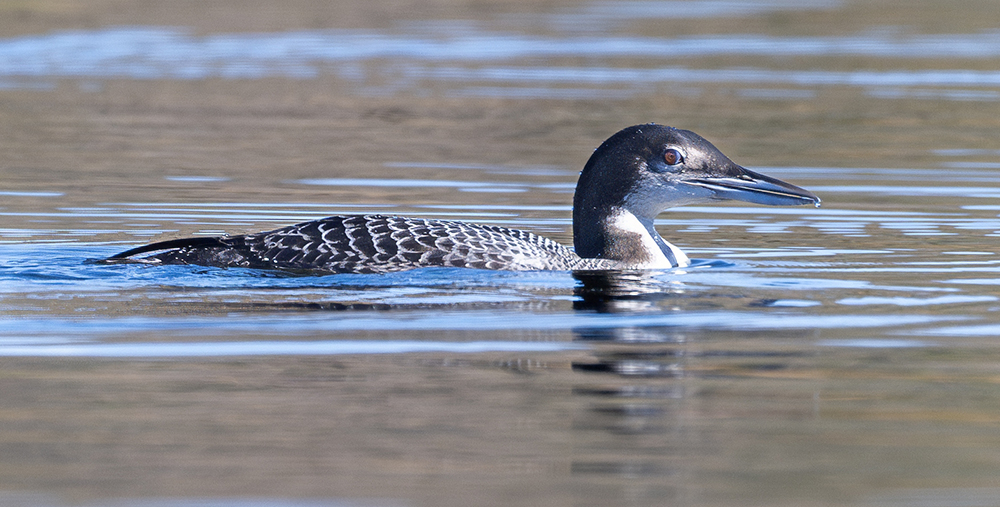
Loons are large, heavy-bodied diving birds roughly the size of a large duck. They have spear-shaped bills, rounded heads, and legs set far back on the body—adaptations that make them superb swimmers but nearly helpless on land. In flight, they exhibit shallow, steady wingbeats and fly in a straight, submarine-like manner just above the water’s surface.
Common Loon (Gavia immer)
The Common Loon is the most frequently encountered loon in Arizona, though still uncommon. Adults in breeding plumage show a black head and neck with a striking white necklace of vertical lines, while winter birds are plain gray above and white below. In Arizona, they are annual migrants and winter visitors, appearing from late fall through winter on large lakes, reservoirs, and wide sections of rivers—most reliably on the Lower Colorado River and in Maricopa County. They forage by diving deeply for fish, often remaining submerged for up to a minute.
Pacific Loon (Gavia pacifica)
Slightly smaller and more slender-billed than the Common Loon, Pacific Loons in breeding season have a darker throat and faint spectacles, but in winter resemble Common Loons except for a slimmer profile. They are less regular in Arizona, occurring primarily as casual winter visitors and migrants. In recent years they have become regular in the Lower Colorado River Valley—especially at Lake Havasu and Lake Mohave—while records elsewhere in the state remain sporadic.
Red-throated Loons (Gavia stellata) are considered casual late-fall and winter visitors in Arizona, with most records coming from the Lower Colorado River Valley and large reservoirs; although one to a few individuals are reported almost annually, they remain sufficiently infrequent to be treated as occasional rather than regular within the state. In stark contrast, Yellow-billed Loons (Gavia adamsii) rank among Arizona’s rarest avian visitors, they number only a handful of accepted records statewide.