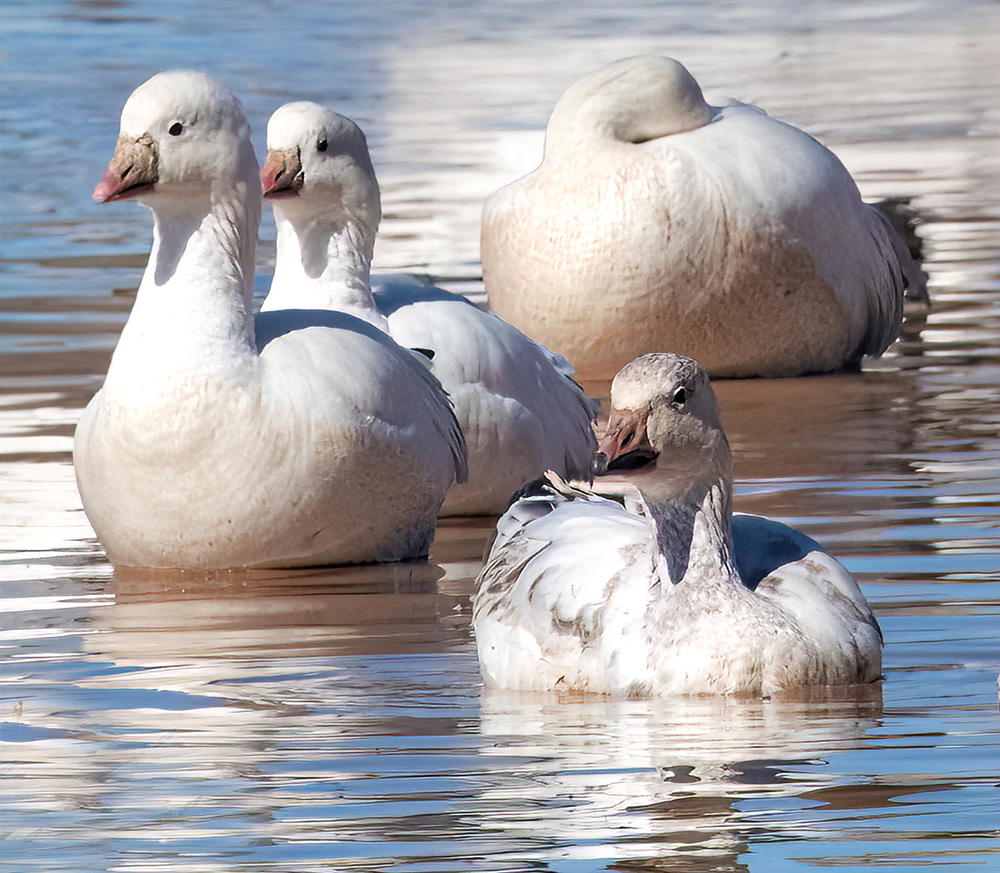
Ross’s Goose is the smallest of the white geese breeding in North America, averaging 23 inches in length, a wingspan of 45 inches, and a weight of 1.2–1.6 kg. Adults are entirely white with contrasting black wingtips visible in flight. Key field-marks include a rounded head atop a short neck, pink legs, and a stubby, triangular pink bill with a bluish base and small warty “knobs” that become more pronounced with age. Unlike the similar Snow Goose (Anser caerulescens), Ross’s Goose is about 40 % smaller, its bill is proportionally shorter and lacks the dark “grinning patch,” and its secondary feathers remain pure white rather than showing any dark centers.
In Arizona, Ross’s Geese are strictly nonbreeding visitors, arriving in late October and departing by mid-March. They are most regularly encountered in the Lower Colorado River corridor—especially within the Imperial-Cibola Conservation Opportunity Area (including Cibola and Imperial National Wildlife Refuges)—where from late October through February they join large flocks of Snow Geese, Canada Geese, and Sandhill Cranes on flooded fields, backwater marshes, and agricultural lands. Occasional sightings also occur at Whitewater Draw Wildlife Area and other southern wetlands, where small numbers (often just a few dozen, but sometimes several hundred) forage on grasses, sedges, and spilled grains.
Compare the two Ross's Geese on the left with the Snow Goose in the foreground.