
Gruiformes in Arizona comprises two families: the marsh‐ and wetland‐dwelling rails, gallinules, and coots (Rallidae), and the large, long‐legged cranes (Gruidae).
Members of Rallidae are small to medium‐sized, secretive wetland birds with strong legs and long toes for walking on soft substrates, short rounded wings, and generally weak flight. They inhabit dense emergent vegetation in marshes, ponds, and riparian areas across the state. Arizona’s seven recorded rallids are:
-
Sora (Porzana carolina) (nesting)
-
Common Gallinule (Gallinula galeata) (nesting)
-
American Coot (Fulica americana) (nesting)
-
Virginia Rail (Rallus limicola) (nesting). A small secretive marsh-dwellers with chestnut flanks and a slate-gray face, occur in Arizona’s freshwater wetlands—most often heard rather than seen during spring and fall migrations at sites like Cienega Creek and the Willcox Playa.
-
Black Rail (Laterallus jamaicensis) (nesting). One of North America’s smallest rails, is an exceedingly rare visitor to Arizona’s marshes—sporadically recorded at Cienega Creek Preserve and Patagonia Salt Marsh, where its soft, repetitive clicking call betrays its hidden presence.
- Ridgway’s Rail (Rallus obsoletus) (nesting). A secretive saltmarsh bird that appears only as an accidental visitor in Arizona, with just a handful of records from the dense marshes along the lower Colorado River near Yuma.
Cranes (Gruidae) are large, long‐necked and long‐legged birds that fly with their necks fully extended, unlike herons). In Arizona, two crane species have been documented:
-
Sandhill Crane (Antigone canadensis) — locally common migrant and occasional nester in marshy grasslands.
-
Common Crane (Grus grus) — a rare accidental visitor.
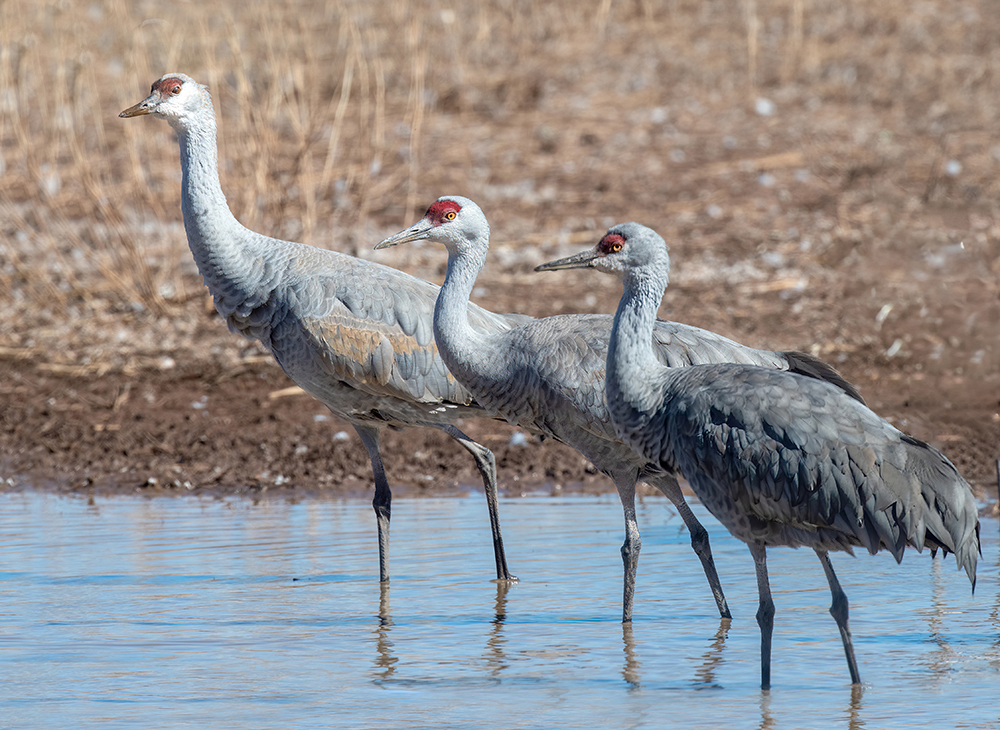
Sandhill Cranes